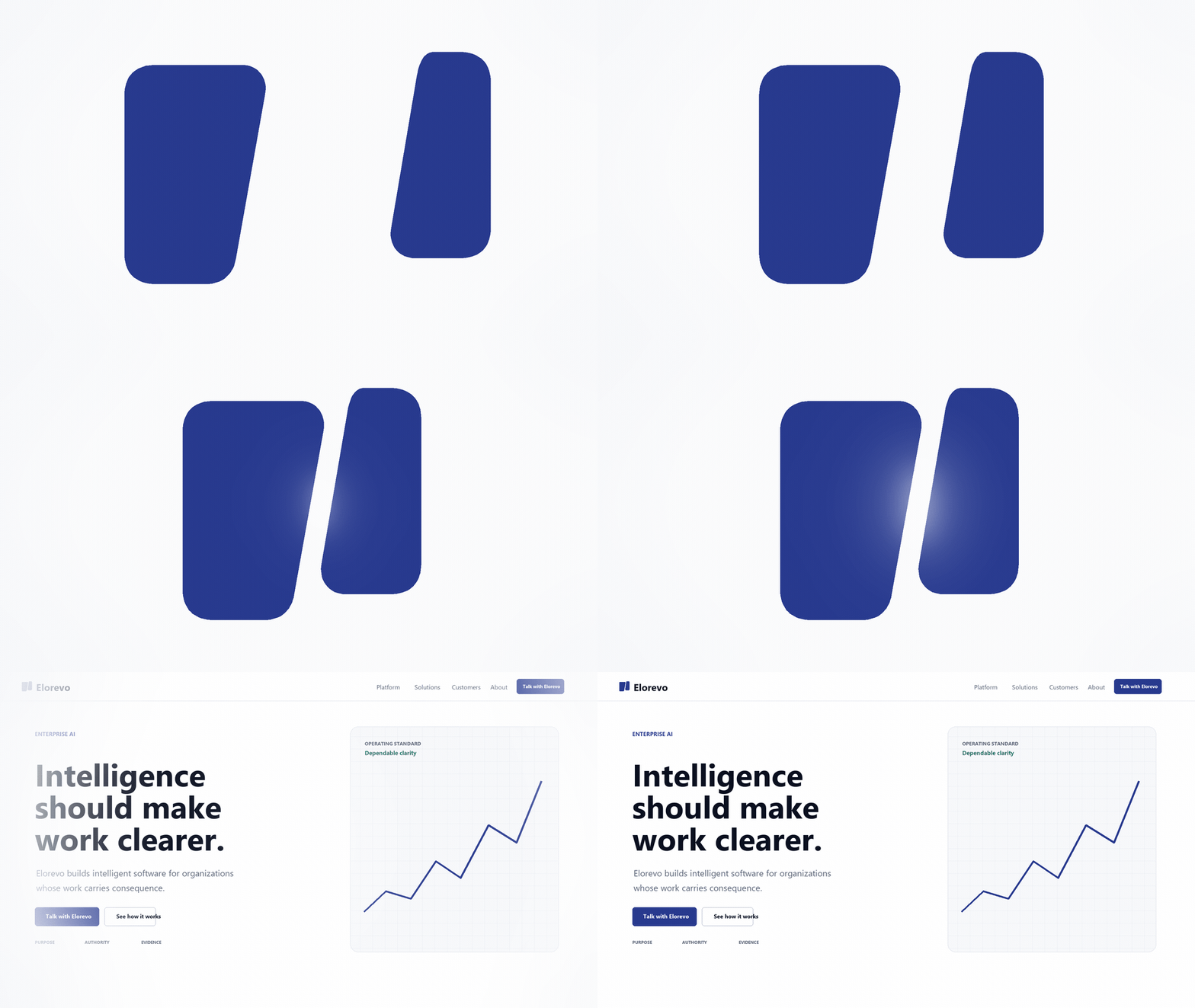
0–420 ms
Distance
Two approved forms wait on a quiet paper-white field. Nothing anticipates the next movement.
Motion identity v2.1 · The Held Breath
The mark does not travel into the website. It becomes complete, waits, and lets light exist on its own before the company is allowed to emerge.
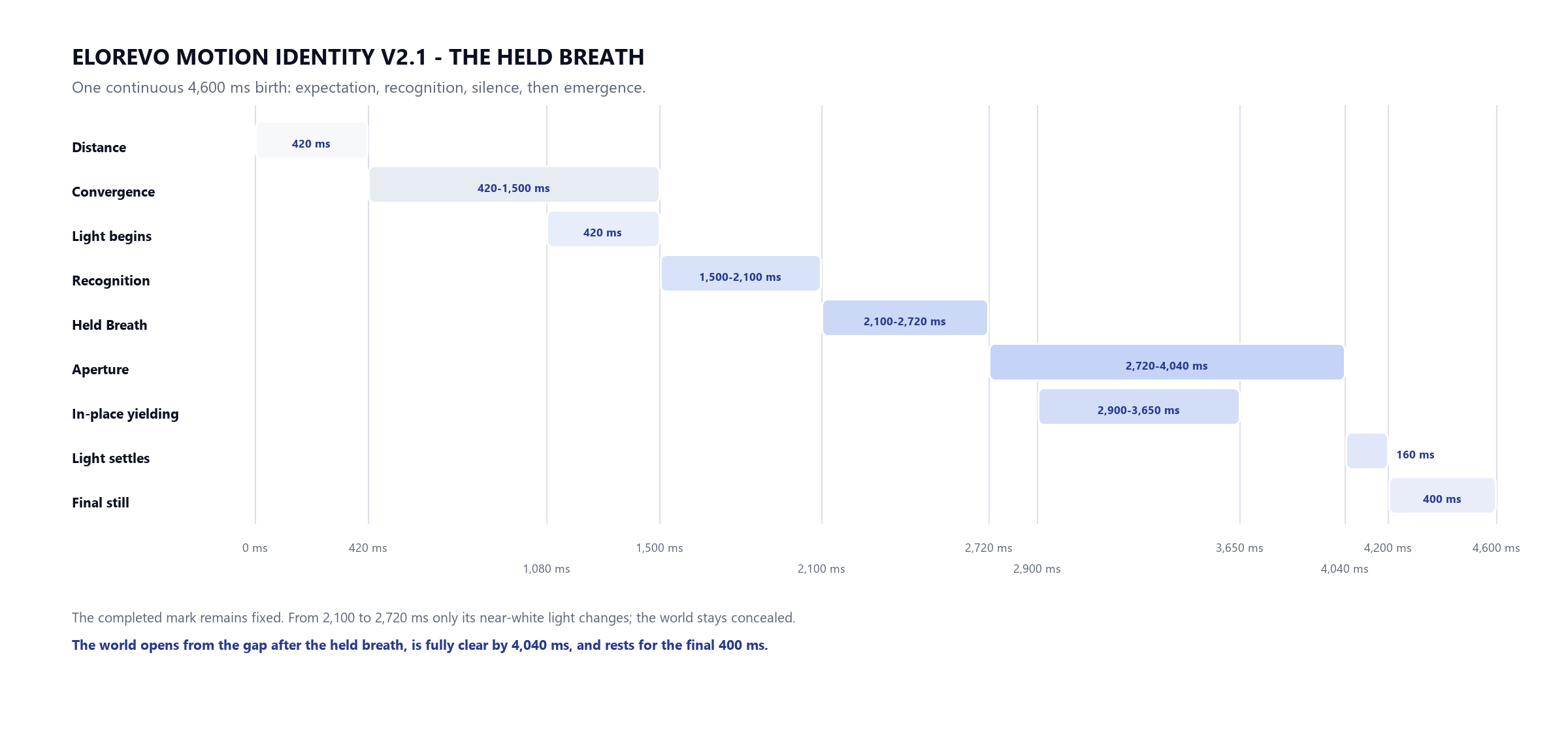
Canonical duration: 4,600 ms · Six movements · Silent · One play per tab session · Reduced-motion safe
Hero intro
The mark becomes complete and remains untouched. For more than a second, the audience sees only relationship and luminance. The already-finished website is revealed only after that held breath.
Logo animation
The approved geometry is unchanged. After convergence, the mark remains optically fixed. It completes its purpose at the centre and is released by the same clarity field that uncovers the permanent identity within the website.
Storyboard
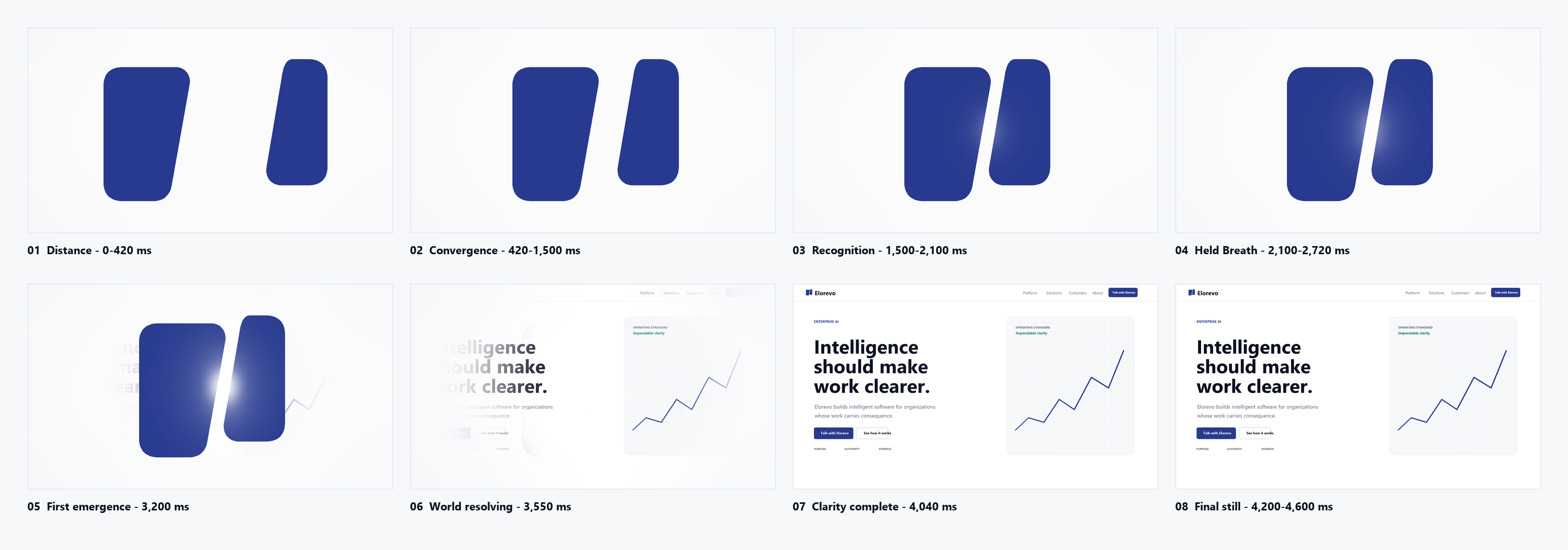
0–420 ms
Two approved forms wait on a quiet paper-white field. Nothing anticipates the next movement.
420–1,500 ms
Both forms close the distance with equal weight. Light begins almost below perception before their relationship is complete.
1,500–2,100 ms
The completed mark becomes absolutely still. The light is given time to become emotionally legible.
2,100–2,720 ms
Only luminance changes. The website remains completely withheld while expectation gathers without spectacle.
2,720–4,200 ms
A broad, back-loaded aperture gradually discloses the already-present world. The mark yields in place; semantic detail arrives slowly.
4,200–4,600 ms
The page is fully sharp, interactive, and still. Nothing travels and nothing continues performing.
Timing
Motion Design System v1.0
Everyday product motion inherits the signature’s continuity, stability, and restraint without imitating the opening aperture.
Motion shows what changed, where it came from, or what now requires attention.
No bounce, overshoot, spring, flourish, or residual ambient movement.
Navigation, controls, and reference frames stay still while the changed region resolves.
Motion never conceals status, delays warnings, or implies completion before evidence exists.
Product motion
Routine motion is shorter than the signature. It preserves context, exposes causality, and stops as soon as the state is understood.
Keep the application shell still. Fade outgoing content for 120 ms, then reveal incoming content over 240 ms with no more than 4 px of travel.
Change colour and border. A primary action may rise 1 px on fine pointers; it never scales, glows, or delays the action.
Use border or shadow and no more than 2 px of vertical travel. Static information cards do not move.
Use quiet fixed-geometry skeleton luminance or measured progress. No bright sweep and no spinner.
Fade the backdrop in 160 ms. Resolve the panel from 8 px below over 240 ms while focus moves immediately.
Enter together from the controlling edge by no more than 4 px. Exit by opacity; never stagger operational choices.
Move from its connected edge. Drawer content stays still inside it and the transition remains interruptible.
Enter by 8 px from the nearest containing edge; leave with opacity and no more than 4 px of travel.
State the completed outcome. A check path may reveal once; there is no bounce, burst, confetti, or full-screen celebration.
Interpolate only between measured values. Never imply 100 percent before completion or animate unverified numbers.
Keep axes, labels, headers, and controls stable. Reveal charts once; crossfade when a scale change would make movement misleading.
Reduced motion: structural movement becomes immediate; colour or opacity feedback may remain for at most 120 ms when it helps recognition. State, focus, and accessibility never wait for animation.
Production sources
Every implementation preserves the stationary completed mark, gap-born clarity, single spatial reveal, approved paths, easing family, reduced-motion behavior, and final state.